Practical examples for your first seat, your next investment and the legacy you keep. These explanations describe the current rules; rival decisions can change your best move.
01 / YOUR FIRST SESSION
Give your first seat a signal.
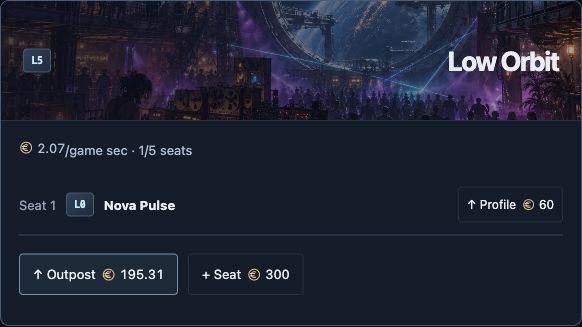
A new empire starts with 1,000 credits, Low Orbit at L1 and one seat. A new, unclaimed L0 profile costs 120 credits. Sign one and assign it to Low Orbit: the profile can now contribute passive income. A signed profile sitting unseated in your Roster earns no outpost income.
In the live galaxy, another player may already have raised the profiles you see. The price reflects the profile’s level, not how famous the person is. If you cannot afford a contract, House Crew costs 120 credits and earns at the basic L0 rate. Crew cannot level, be poached or earn Hall of Fame ranks. You can also transmit from an empty seat once per second to earn a small starting payout.
A fictional training example. Real galaxies have their own profile pool and progression speed.
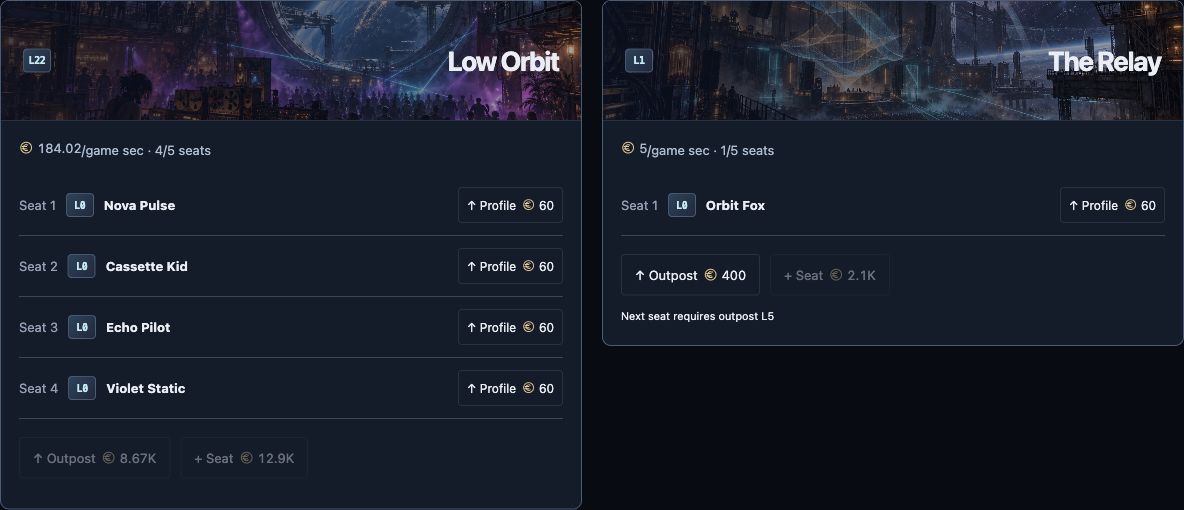
Work toward Low Orbit L5 before buying seat two. Additional seats require L12, L22 and L35. Unlocking The Relay requires Low Orbit L22, four purchased seats, at least three occupied seats and 75,000 available credits. Those credits pay for the unlock; having them in lifetime score does not make them spendable.
Try the two-outpost guided demo to practice without an X account. Its income runs at 120× training speed, and its progress never transfers to the live game.
02 / SPEND WITH A PURPOSE
Upgrade a profile, a station, or the seating?
An outpost upgrade improves that station’s throughput by 20%. If several seats are occupied, all of them benefit. A profile upgrade improves the income contribution of that one profile, and the benefit travels with it when you move it. Buying a seat creates capacity; it only becomes passive income once you fill it.
For a plain new empire with one L0 profile at Low Orbit L1, that seat earns 1 credit per second. Spending 80 credits on outpost L2 raises it to 1.2 credits per second: an extra 0.2, giving a simple 400-second payback. Spending 60 credits on the L0 profile’s first upgrade raises its contribution from 1 to 1.18 at the original outpost level: an extra 0.18, or roughly 333 seconds to earn back the upgrade. These examples exclude other bonuses and rival activity. They are comparisons, not a promise of the best move.
As more seats fill, station upgrades benefit more profiles. As a profile’s level rises, its price and upgrade cost rise by 50% per level, while its level-based income contribution grows more gradually. Look at the extra income you receive for the cost, and the requirements for the next unlock, rather than assuming the largest number is always the best purchase.
You can hold more contracts than you can seat. Keep reserves when useful, but remember they produce no passive income. Moving a contract into a full outpost unseats its lowest-level occupant into your Roster; it does not swap that occupant into the incoming profile’s old seat.
03 / A SHARED PROFILE POOL
Every poach has two sides.
A buyer pays the listed contract price. The previous holder receives 90% of that amount; the withheld 10% reduces their lifetime score. The buyer gains the contract and the profile rises one level. There is no protection period: a rival can buy it back immediately if they can afford the new price.
For an L0 contract priced at 120 credits, a poach pays its holder 108 credits and withholds 12 from their lifetime score. The profile becomes L1 and its next contract price is 180 credits. The buyer’s initial payment stays 120; the 180 is the next price after the level increase.
Manual upgrades cost half of the current contract price. All profiles at the same level use the same curve. Names, images and social follower counts do not set the price. Levels do not rise simply because time passes.
Buying and selling a contract represents a game action only. It grants no rights to the person, account or their content. A profile may be listed without its owner joining or endorsing ZSR.
04 / A DIFFERENT ECONOMY
The gold coin and the violet signal.
The gold coin marks credits. They pay for contracts, profile upgrades, basic outpost upgrades and the first Broadcast Network founding. The violet diamond waveform marks Resonance. It comes only from the four advanced outposts and pays for their upgrades, extra seats, later advanced unlocks and prestige.
After opening all six basic outposts, prepare Event Horizon at L22 with four purchased seats and at least three occupied. Founding the network costs 60 billion credits and opens Pulsar Array. This is the bridge into Resonance: you do not need Resonance to found that first advanced outpost.
Advanced stations still generate credits from occupied seats. They also have their own Resonance production, increased by occupied contracts. You cannot pay a Resonance upgrade with credits, regardless of how large your credit wallet becomes. Unclaimed income must be collected before it is spendable.
Each station has its own level and seating. Later live-game stations also introduce the separate Resonance currency.
05 / WHAT CARRIES FORWARD
A profile resets. Your record remains.
Profiles start at L0. The action that takes one from L49 to L50 awards the acting player a Hall of Fame rank for that profile. It then immediately resets to unclaimed L0, leaves its contract and seat, and returns to the shared pool. The game asks you to confirm that final upgrade or poach because you are releasing a strong current earner.
If you complete the same profile’s cycle four times, your Hall record for it reaches rank 4. Another player completing it changes their own record, never yours. You keep every Hall entry across prestige in the same empire, but only the ten highest distinct profile ranks contribute to its earnings bonus.
Prestige resets the current run: contracts, outposts, seating, wallets, Resonance and unclaimed income. You start again at Low Orbit with 1,000 credits. Your empire’s prestige count, Hall records and lifetime score remain. The first prestige needs 45 million Resonance; later requirements grow by 2.2× per prestige, alongside the income benefits you carry forward. Check the live reset review before confirming.
06 / CHOOSE YOUR CONTEST
Your permanent empire and a fresh season.
The permanent leaderboard rewards lifetime credits earned minus withheld poach fees. Spending and prestige preserve that score. Receiving a resale payout does not inflate it. This is a long-running contest, so established players have a head start.
Optional 28-day seasons provide separate fresh economies. Every entrant starts that seasonal empire without permanent bonuses. Joining late gives you less time in that season; it does not backdate your start or award catch-up currency. A new season provides another fresh contest.
Seasonal balances, contracts, Hall ranks and bonuses stay inside the season. Switching back to your permanent empire preserves its separate progress. The current deadline and standings are shown in-game, and the scoring and reset rules are described on the seasons page.